Group 4 Film Opening


Tuesday, 25 March 2014

Kayvon Nabijou - Question 7: Looking back at your preliminary task, what do you feel you have learnt in the progression from it to the full product?


The purpose of our preliminary task was primarily to practice obeying continuity theory (180-degree rule, 30-degree rule, match-on-action, shot-reverse-shot) as well as practice in pre-production, production and post-production. In our film opening, we had to consider continuity theory alongside all the other considerations that come with a film opening such as style and narrative.


Pre-production

Preliminary Task

Pre-production for our preliminary task was relatively limited compared to our film opening. We had to decide on a genre of film to create a scene from. We also had to consider the audience for the film and create a basic storyboard to make sure we had a variety of shots and that continuity was kept throughout the sequence.


Film Opening


Pre-production was a very big part of our film opening. It was broken down into two sections - research and planning. Our research included finding films with similar aspects to our own idea such as genre, style, narrative and similar characters, settings and events. We also researched different audiences for these films, helping us identify our own target audience. We put this research together into a pitch about our film opening, backed up by our research, which we pitched to our teachers and class. The handout which we gave to the class and spoke about is shown below.


Once our sequence was edited and approved (originally the break up scene was not going to be in our sequence) we created a storyboard so that we could visually see our opening and colour-coded each shot according to framing so that we could see if we had shot variety.

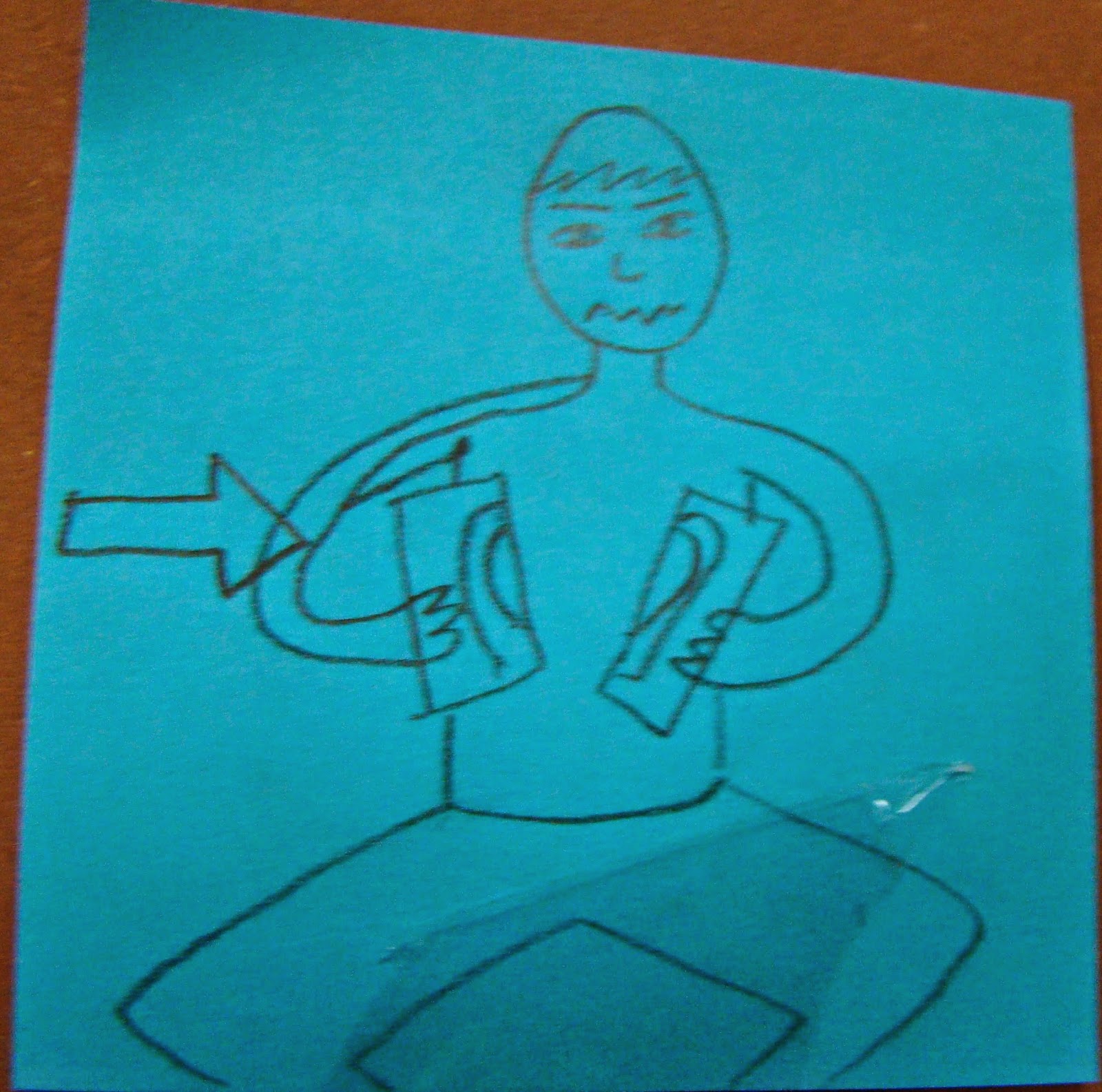


An early version of our storyboard

We then created a shoot board which we took on set to organise our time and shots:


What have I learnt?

As the pre-production stage of our preliminary tasks was much more basic than for our film opening, a lot of the research and planning stage was learnt as I went along. I have learnt to effectively plan a shoot with appropriate time set out for each shot with the use of a shoot board, and how to make sure our sequence has compositional variety and creativity through the use of a storyboard. I have also learned how important it is to research each creative decision we make about our film opening and how it will be received by the audience, using other similar films to back up our conclusions.

Production

Preliminary Task

Due to time restrictions, we only had about 45 minutes to get our shoot done. This meant that we had to be very efficient when shooting, which was good practice for our main shoots, when we had much more footage to shoot and to a higher standard. We were therefore:
  • Forced to think about practicality issues that may arise in our real shoot (e.g. weather)
  • Able to get some extra practice with the camera
  • Able to polish up our acting skills
  • Able to practice using our shoot board effectively to handle our very limited time

Film Opening


Our shooting time was much longer and we had 3 weekends to do it. This meant that we had more flexibility in our shoot board timetable. The preliminary task helped us understand the importance of continuity:


180-degree rule 

If you place an imaginary line between the two people exchanging dialogue, the camera cannot cross over from one side of this line to the other.

Prelim:


Film Opening:


30-degree rule

The camera must turn through an angle of at least 30-degrees from one shot to another.

Prelim:


Film Opening:


Match-on-action

Two shots that have been shot from different angles are edited together to make the action in each shot look seamless.

Prelim:


Film Opening:


Shot-reverse-shot

The camera cuts from one person speaking to the other person speaking and them back to the first, with the camera moving very little in position, only in angle
Prelim:


Film Opening:


Gavin filming some outdoor shots

What have I learnt?

Through dedicating the preliminary task greatly to the consideration of continuity, I was careful to keep this near the front of my mind when shooting or directing shots. Despite all our efforts, the final ice-cream-crush shot has break of continuity as part of the ice-cream is still on the cone in one shot, and suddenly not on the cone in the next shot. Nevertheless, I learned of the importance of continuity and how drastically it can affect the final outcome of the work.

Post-production


Preliminary Task

Editing was very basic for our preliminary task - it only involved cutting our shots together into a sequence. This served as a nice recap on basic editing but didn't give us any practice on titles or grading. When editing, we realised that we hadn't let the camera run for long enough on some occasions and so when filming our film opening, we made sure there was plenty of footage either side of the useful footage.


Film Opening

Editing our preliminary task meant that basic cutting together was much faster, meaning that we could focus on our titles. Through the activity of editing a (relatively) long piece of work, I feel much more versatile around Premiere Pro and can confidently cut together a sequence effectively.

What have I learnt?

Before this task, I had never used Adobe: After Effects, and now I can use it to create titles that are integrated with the shot itself. I also feel more confident in cutting together a sequence alone. I would have liked to have had more of a chance to grade the shots, as most of the grading was done by other people in my group.


Monday, 24 March 2014

Alice Cahill, Question 1: In what ways does your media product use, develop or challenge forms and conventions of real media products?

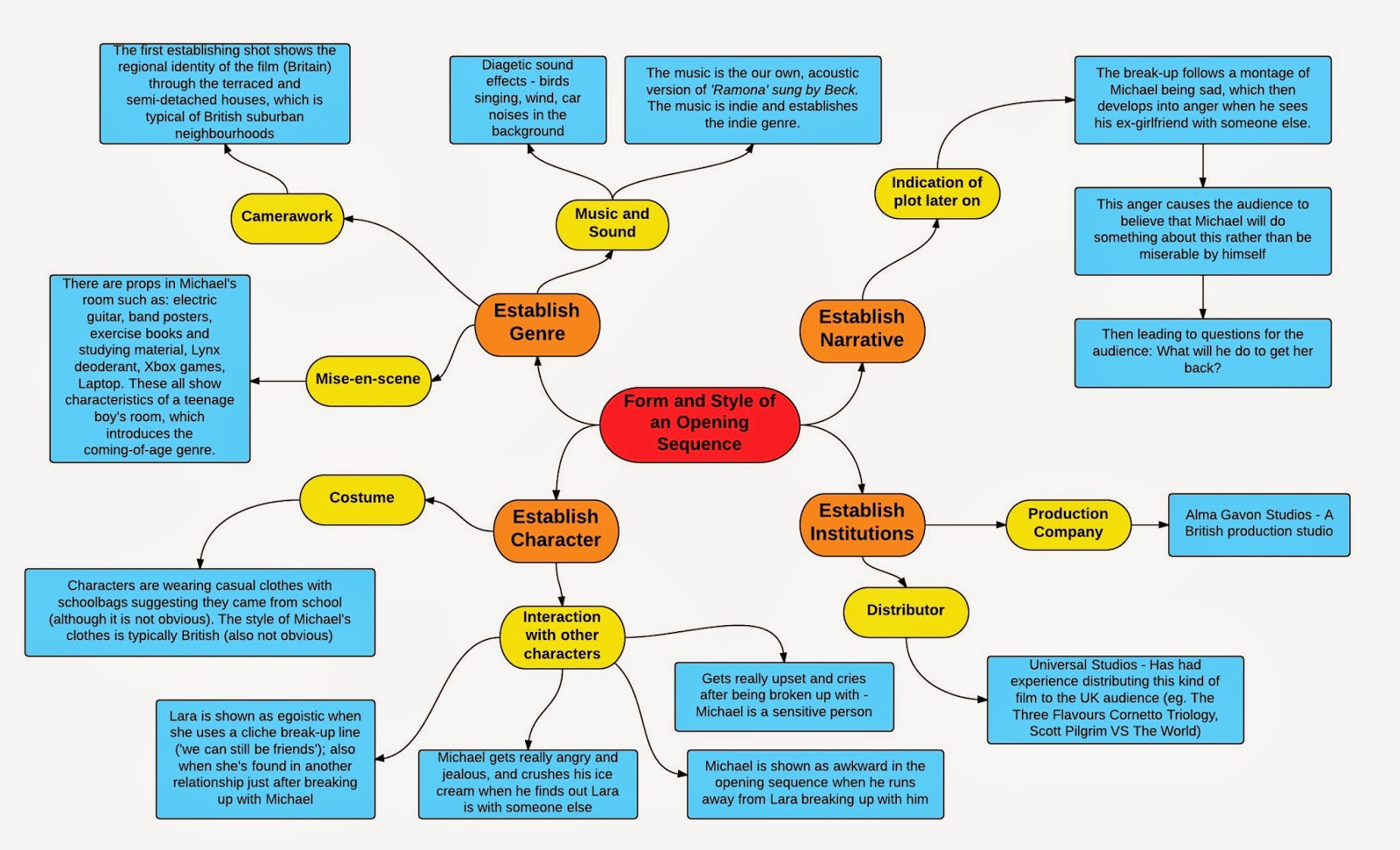
Michael is a coming-of-age, romance, comedy film. To answer this question I have separated it into 4 sections: genre, narrative, form and style.

We watched many teen romance, rom-com, and teen comedy films, as well as independent and British films. From this research, we used the information to plan our characters, narrative and style.

Genre

Some of the common genre conventions we found:

Genre Conventions:
Media Text Example:

Challenged or conformed?

Teenage male protagonist (often awkward or is different to other characters)
Noah Taylor (Submarine)

Conformed
Male protagonist, Michael, is awkward and quirky

Plot focused on protagonist's journey
The plot focuses on Scott Pilgrim's (the protagonist) journey to win/win back Ramona (Scott Pilgrim VS The World)

Conformed
The film follows Michael's story and his plan to get Lara (his ex-girlfriend) back

A quirky best friend who follows protagonist on their journey
Leah, Juno's best friend (Juno)

Conformed
Tris, Michael's quirky best friend, is there throughout the whole film with Michael, helping him get Lara back
A friend who develops into a love interest for the protagonist

Todd and Olive (Easy A)

Conformed
Tris is also the friend who, in the end, becomes the love interest for Michael
Protagonist is currently going through a major transitional period of their life (dark themes)
Tyler's parents split up in the beginning of the film due to the event of his brother's suicide (Remember Me)

Challenged
We do not focus on any dark themes, our media product focuses on less complex themes, such as teenage love 
Secondary School/ High School Setting
Set in an American High School (Juno)

Conformed
Our film is set in a British secondary school
Protagonist usually matures or seeks self independence
At the end, Scott learns that he must have self-respect and be open to friendship before he can have a mature relationship. 

Conformed
In the end Michael understands how fickle and self-centred Lara is and falls for Tris instead who has been there all along
Mutual friend between love interest and protagonist
Patrick is the link between Sam and Charlie (The Perks of Being a Wallflower)

Conformed
Michael's friend, Louis, is a mutual friend between Tris and him 
Love interest currently has a popular/pretty partner
Regina George (the popular/pretty partner) and Aaron Samuels (the love interest) are together (Mean Girls)

Conformed
Lara (the initial love interest) goes out with Brad Douché, who is more popular/'better' than Michael

Protagonist has an unusual Family
Overly protective father who will not let his youngest daughter date (10 things I hate about you)
Challenged
Michael's family are not focused on much in the film opening or the film

Narrative:

Todorov's Narrative Theory
We took influence from Todorov's narrative theory, but did not fully conform to a classic narrative pattern.
We started the film off with disequilibrium, then added a secondary disruption which was then solved and then ended with the conventional 'new equilibrium:


A reference point for of our narrative theory is Freaky Friday (2003):


Levi- Strauss Theory of Binary Opposites
We also set up the following binary opposites:
  • Male VS female
  • Single VS In a relationship
  • Sad VS Happy
  • Good VS Evil (Michael VS Brad)
Propp's Character Theory
Our characters conform to Propp's Character Theory:
  • Hero = Michael
  • Villain = Brad
  • Helper = Tris
  • Princess = Lara
However we did not include the false hero, donor or dispatcher

Enigma Codes
Our opening will set up questions like:
  • Why did Lara break up with Michael?
  • Who is Brad?
  • What will he do to get her back?
  • Will he get her back?
Semiotic Codes


Michael crushing the ice-cream shows his anger and his desire for revenge


Michael writing a list of 'why you should take me back' to Lara, demonstrates his distress and how hopeless and desperate he is to get her back


Michael crying implies his misery


Michael ripping up the paper with force and also the broken biscuit on the table of the other shot suggests his anger and annoyance with Lara, but also how upset he is


Cultural Codes
  • Terraced/semi-detached houses - UK (London)
  • Music culture references on Michael's bedroom wall:
    • My Chemical Romance poster (Punk Rock) (US)
    • One Direction cardboard cutout (Pop) (UK)
    • Jimi Hendrix poster (Classic Rock) (US)
    • Radiohead poster (Alternative Rock) (UK)

Action Codes
We challenged action codes, as Michael's behaviour is unpredictable in our opening.
This was done to make the opening more interesting and enigmatic


Symbolic Code

Time passing showed through the montage - typically a montage is showing an extended period of time

For example the opening of Hot Fuzz (2007):

Form:

We also conformed to the typical form of an opening sequence, to establish genre, narrative, (some) characters and institutions:

Style

Titles:
After looking at some indie and British film openings we found that the fonts used are a simple Sans Serif, this was done to not draw the attention away from the visuals happening on screen:
Scott Pilgrim VS The World (2010)
Submarine (2010)
Youth In Revolt (2009)
We conformed to this and used a very simple font:

The font for our opening title sequence
Also we decided to use integrated titles to make the titles more interesting and push ourselves futher. This was influenced by Scott Pilgrim VS The World (2010) and Zombieland (2009), which are not typically indie rom-com films, but we asked members of our core audience and they thought it added to the opening and made it more interesting.

Scott Pilgrim VS The World (2010) Integrated Titles
Zombieland (2009) Integrated Titles

Colours and Grading:

We chose to grade our opening to give the product a more natural and realistic look:

Shot from Michael
Colour Scheme from Michael

This low-key lighting and natural grading is typical of independent films. For example, from About Time (2013) and Submarine (2010), which both have similar genres as Michael:

Shot from About Time (2013)
Colour Scheme from About Time (2013)

Shot from Submarine (2010)
Colour Scheme from Submarine (2010)
This is more obvious when compared to high budget, hollywood blockbuster films, which use more vibrant colours:

Shot from The Amazing Spiderman 2 (2014) 
Soundtrack:

In the opening scene we wanted the soundtrack to establish and reflect the style of our genre

This is our soundtrack:


We felt this song was a good choice as the acoustic guitar added to the indie style and the slow rhythm established the romantic and sad moods

An example of this is the opening of Submarine (2010), which use a slow piano and guitar song which makes the indie style obvious.